In modern interior design, lighting is far more than a functional necessity—it is the subtle architectural tool that defines the mood, spatial proportion, and focal points of your home. Nowhere is this more critical than in the dining room. As a space dedicated to gathering, conversation, and shared meals, the dining area demands an intentional lighting scheme that balances warm hospitality with striking visual form.
A single overhead bulb or an improperly scaled fixture can leave a dining space feeling cold, flat, or uncomfortably bright. Conversely, a layered lighting strategy—combining sculptural ambient pendants, warm wall sconces, and subtle accent lighting—transforms the tabletop into a welcoming sanctuary.
Here is an architectural guide to ten elevated dining room lighting concepts, crafted to help you design a luminous, balanced, and beautifully proportioned space.

1. The Sculptural Architectural Statement Chandelier
For dining rooms with high or vaulted ceilings, an oversized, sculptural statement chandelier acts as a grand piece of suspended ceiling art. Rather than traditional crystal drops, contemporary lighting design favors clean geometric lines, kinetic arms, and organic blown-glass forms.
Architectural Principles & Design Strategy
- Scale & Proportion: To determine the ideal diameter for a central chandelier, add the width and length of your dining room in feet; the sum translates directly into the recommended fixture diameter in inches. For example, a $12\times15\text{-foot}$ room calls for a fixture approximately $27\text{ inches}$ in diameter.
- Hanging Clearance: The bottom edge of an overhead chandelier should hang between $30\text{ and }36\text{ inches}$ ($75\text{ to }90\text{ cm}$) above the top surface of the dining table. This provides clear sightlines across the table while keeping the light source intimate.
- Visual Mass: In minimalist or open-plan homes, opt for open-frame, wire, or slim linear chandelier designs that allow light and air to pass through without blocking views.
Design Tip: Pair a large sculptural fixture with a smooth-operating dimmer switch. Being able to dial illumination down from bright prep lighting to a soft $2700\text{K}$ evening glow is essential for creating atmosphere.

2. The Linear LED Suspended Pendant Array
Ideal for long, rectangular dining tables, a modern linear LED pendant provides continuous, shadow-free illumination across the entire length of the tabletop.
Architectural Principles & Design Strategy
- Coverage Balance: A linear light fixture should measure approximately $60\%\text{ to }75\%$ of the total length of your dining table. A fixture that is too short leaves the table ends in shadow; one that extends beyond the table edge feels unbalanced.
- Minimalist Silhouette: Ultra-thin brass, matte black, or brushed aluminum linear bars introduce a sleek, modern aesthetic that works seamlessly in Scandinavian and industrial spaces.
- Up/Down Light Distribution: Select linear fixtures that feature both direct downward task lighting for the table and indirect upward ambient light to bounce soft brightness off the ceiling.

3. The Organic Blown-Glass Bubble Cluster
Introducing soft, organic geometry to a room filled with hard, straight lines—such as rectangular tables, doors, and sideboards—can be achieved using a clustered bubble pendant arrangement.
Architectural Principles & Design Strategy
- Tactile Transparency: Clear, smoked, or amber-tinted hand-blown glass globes catch and refract light, creating a shimmering focal point that feels light and airy.
- Cascading Heights: Arrange individual glass pendants at slightly varying heights to build a multi-dimensional, cloud-like silhouette above round or square dining tables.
- Warm Filament Bulbs: Pair glass globes with warm-toned LED filament bulbs ($2200\text{K}$ to $2700\text{K}$) to mimic the romantic, golden glow of candlelight.

4. The Modern Drum Shade Pendant with Soft Diffusers
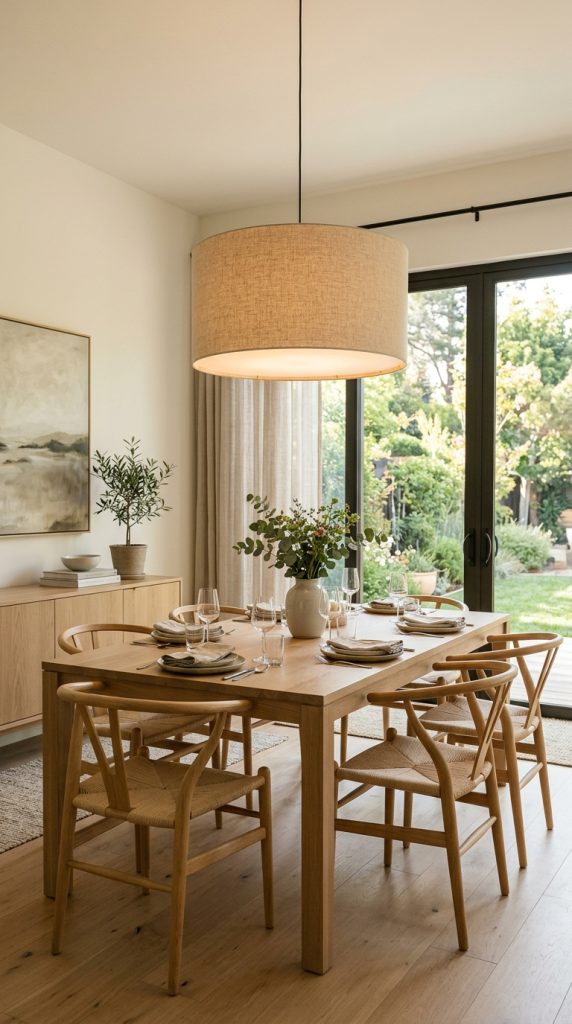
If you prefer soft, diffused illumination over direct exposed bulbs, a large-scale drum shade pendant covered in natural linen, silk, or textured parchment provides glare-free light.
Architectural Principles & Design Strategy
- Bottom Diffusers: Ensure the drum shade includes an acrylic or frosted glass bottom diffuser panel. This hides bare bulbs from view and softens downward light onto guests below.
- Material Harmony: Choose natural textile fabrics—such as oat linen, unbleached cotton, or woven jute—to introduce soft tactile warmth that complements wooden dining sets.
- Acoustic Softening: Fabric shades absorb subtle room echoes, contributing to a quieter, more acoustic dining environment.
5. Modern Flanking Wall Sconces & Sideboard Accent Lighting
Relying entirely on a central ceiling fixture can create harsh downward shadows on guests’ faces. Incorporating a pair of sculptural wall sconces on the surrounding walls fills side shadows and adds visual depth to the room’s perimeter.
Architectural Principles & Design Strategy
- Perimeter Layering: Mount sconces on either side of a large piece of wall art, a mirror, or above a dining room buffet sideboard to create a balanced, layered lighting scheme.
- Eye-Level Mounting: Position wall sconces so the light center sits approximately $60\text{ to }65\text{ inches}$ ($150\text{ to }165\text{ cm}$) from the finished floor.
- Up-and-Down Wash: Select sconce fixtures that direct light both upward and downward along the wall surface, highlighting plaster textures or wall treatments.

6. The Flush Architectural Ceiling Cove & Concealed LED Strips
For ultra-minimalist, contemporary, or low-ceiling dining spaces where hanging pendants might feel visually intrusive, concealed LED perimeter cove lighting offers a sleek architectural solution.
Architectural Principles & Design Strategy
- Indirect Ambient Lighting: Hiding high-CRI LED strip channels inside a recessed ceiling soffit or floating drywall tray casts a soft, shadowless glow across the ceiling, giving the illusion of a floating ceiling.
- Spatial Expansion: Wall-washing light techniques draw the eye outward, making compact dining rooms feel significantly larger and airier.
- Color Tuning: Install smart dimmable LED channels that allow you to adjust color temperatures from crisp daylight ($4000\text{K}$) down to warm sunset tones ($1800\text{K}$).

7. The Natural Woven Rattan & Basket Pendant Grouping
Infuse relaxed, organic modern warmth or coastal elegance into your dining area by hanging oversized woven rattan, seagrass, or bamboo basket lampshades.
Architectural Principles & Design Strategy
- Light & Shadow Play: The open weave of woven basket pendants projects dramatic, dappled shadow patterns across the ceiling and surrounding walls, adding movement to the room.
- Grouping Dynamics: Hang a trio of woven pendants in varying shapes—such as dome, bell, and teardrop silhouettes—at staggered heights over a raw wood dining table.
- Eco-Friendly Texture: Natural fibers soften hard materials like concrete, glass, and steel, making the dining area feel grounded and inviting.

8. The Articulated Industrial Swing-Arm Wall Lamp
For off-center dining tables, open-plan lofts, or dining nooks where ceiling wiring is not centered, an oversized articulated swing-arm wall lamp provides a flexible and stylish solution.
Architectural Principles & Design Strategy
- Flexible Reach: Mounting a long, counterbalanced swing arm onto a side wall allows you to position the light shade directly over the center of the table when dining, and fold it flat against the wall afterward.
- Industrial Elegance: Matte black iron, brushed steel, or raw brass armatures bring a utilitarian, mid-century architectural aesthetic to contemporary dining spaces.
- Plugin Efficiency: Many swing-arm lamps can be plugged directly into wall outlets, eliminating the need for invasive electrical rewiring.

9. Integrated Bookcase & Display Cabinet Accent Lighting
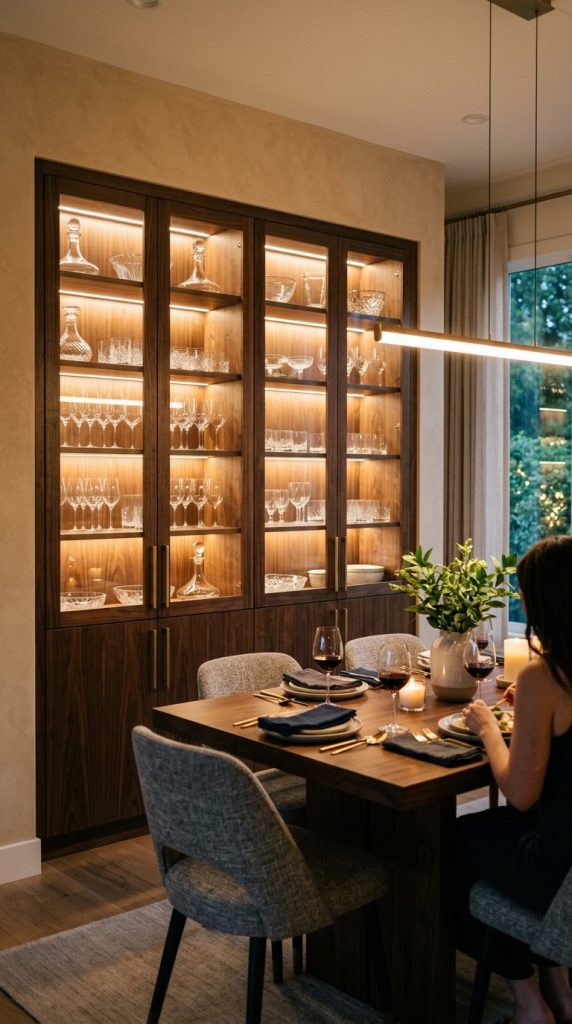
If your dining room features built-in china cabinets, bar carts, or display shelving, integrating micro LED puck lights or recessed channel strips inside the cabinetry introduces subtle ambient glow.
Architectural Principles & Design Strategy
- High-Contrast Display: Illuminating glassware, ceramics, and wine bottles from within creates a glowing backdrop behind the main dining table, adding depth to the room.
- Low-Voltage Accent: Keep cabinet accent lighting soft ($2700\text{K}$, low wattage) so it complements—rather than competes with—the main table lighting.
- Glass Shelving: Use glass shelves inside cabinets to allow light to filter continuously from top to bottom.
10. The Multi-Pendant Cluster over Round Tables
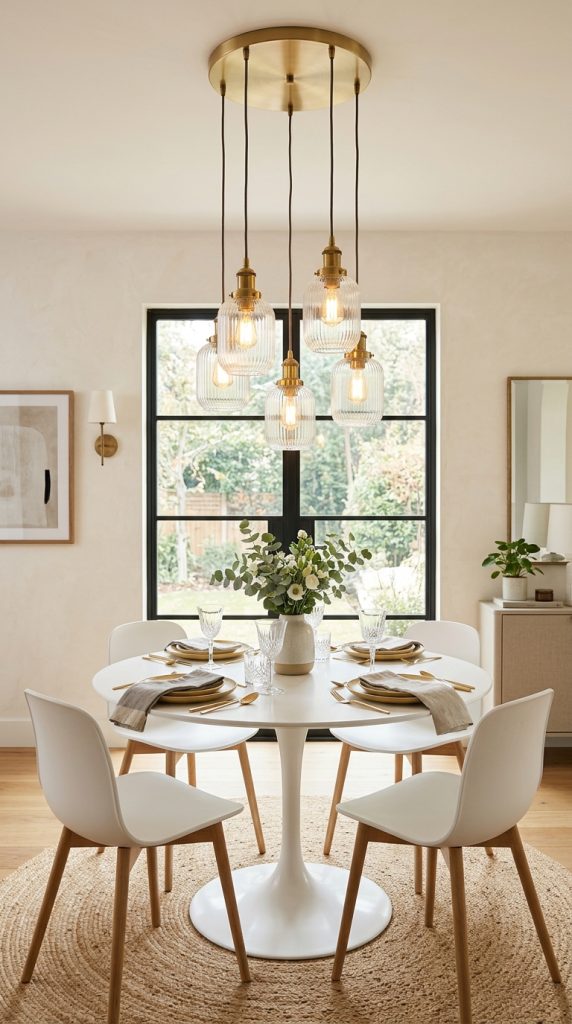
While long tables benefit from linear fixtures, round dining tables naturally pair best with radial or clustered pendant configurations that mimic their circular symmetry.
Architectural Principles & Design Strategy
- Central Anchor: Grouping three to seven individual mini-pendants around a central ceiling plate builds a balanced, rounded lighting canopy that anchors a circular table.
- Varied Materials: Experiment with mixed materials within the cluster—such as pairing frosted glass, brass, and matte ceramic pendant drops together.
- Symmetrical Spread: Ensure the outer edges of the pendant cluster remain at least $10\text{ to }12\text{ inches}$ inside the perimeter of the round table to prevent head bumps when standing up.