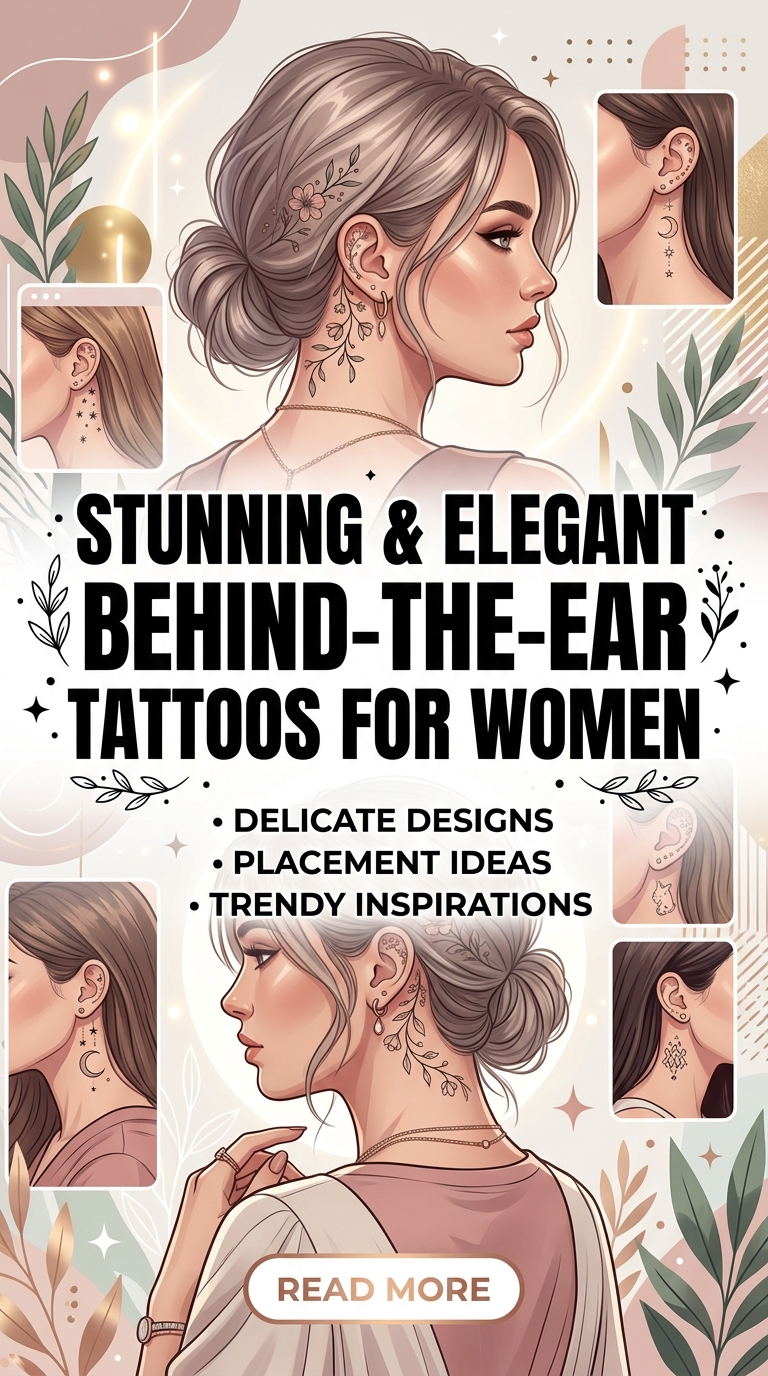
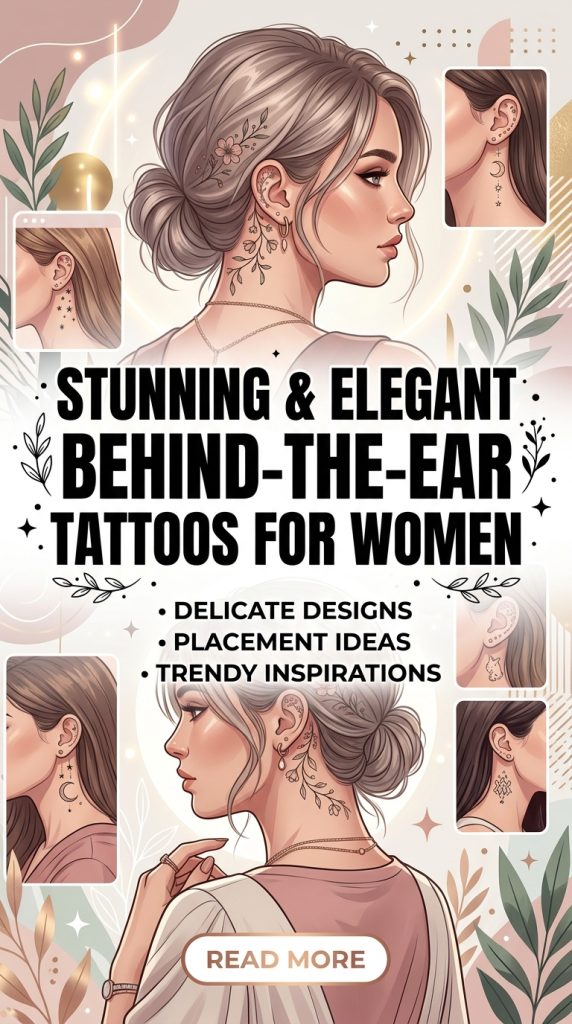
Tattoos placed behind the ear represent one of the most intriguing, elegant, and versatile forms of body art available today. Sitting discreetly at the intersection of the jawline, hair, and neck, a behind-the-ear tattoo offers a unique balance of intimacy and self-expression. It can be effortlessly concealed under flowing hair during professional settings or framed as a striking statement piece when hair is styled up in a sleek bun or ponytail.
Because the skin behind the ear is thin, delicate, and uniquely contoured around the mastoid bone, selecting the right design requires careful consideration of scale, line weight, and anatomical flow. The most compelling behind-the-ear tattoos respect this small natural canvas, turning a discreet space into a powerful visual anchor.
Here is an in-depth guide to ten stunning behind-the-ear tattoo ideas for women—complete with design aesthetics, anatomical placement tips, pain management insights, and long-term care guidelines.
The Anatomy & Engineering of Behind-the-Ear Tattoos
Placing a tattoo behind the ear is significantly different from tattooing a flat surface like the forearm or thigh. Success comes down to understanding the unique characteristics of this canvas:
1. Spatial Real Estate & Scale
The actual canvas behind the human ear measures roughly $1.5\text{ to }2.5\text{ inches}$ in height and less than $1.5\text{ inches}$ in width. Attempting to fit complex compositions with multiple focal points will result in visual clutter. Stick to single-subject concepts, minimalist silhouettes, or single-needle line work.
2. Anatomical Flow
The crease where the back of the ear cartilage meets the skull forms a natural, gentle S-curve. Designs that utilize this curve—such as trailing floral vines, crescent moons, or fluid script—look organic and custom-tailored, whereas rigid boxy shapes can feel out of place.
3. Pain Expectations & Bone Proximity
The skin over the mastoid bone is thin, with minimal subcutaneous fat and high concentration of nerve endings. The vibrating sensation from the tattoo machine transfers directly to the bone, which creates an intense buzz that can feel louder due to its proximity to the ear canal. While the area is sensitive, behind-the-ear tattoos are typically small, meaning most sessions take under 30 to 45 minutes.
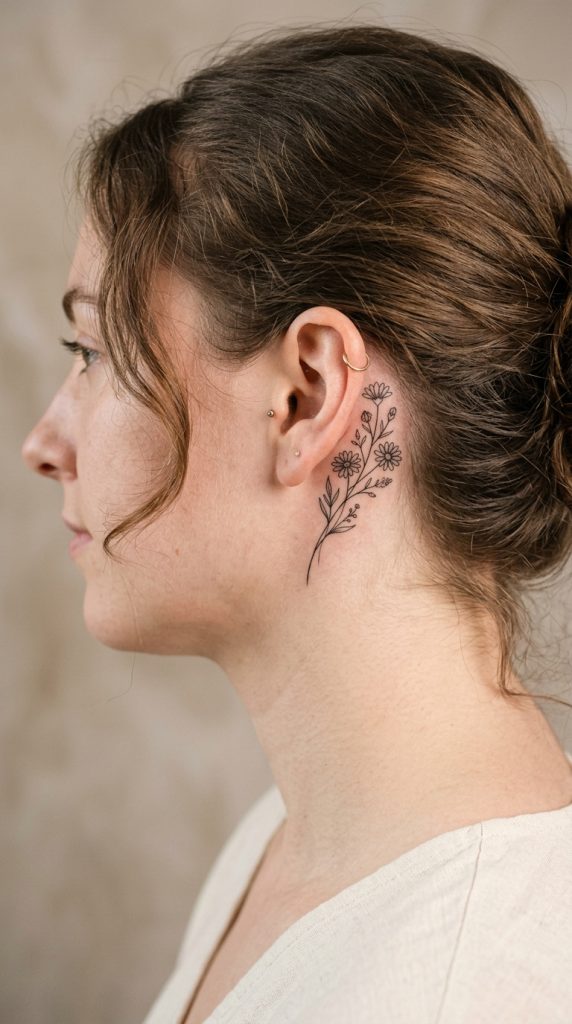
1. The Micro Fine-Line Wildflower Stem
Fine-line botanical tattoos remain a gold standard for behind-the-ear placement. A delicate wildflower stem following the natural curve behind the ear offers an airy, romantic, and effortlessly chic aesthetic.
Design Specs & Placement Dynamics
- Line Weight: Single-needle ($1\text{RL}$) or ultra-fine three-needle ($3\text{RL}$) groupings.
- Flow: Position the bloom near the top cartilage curve, allowing the stem to trace downward into the shadow behind the ear lobe.
- Motifs: Lavender sprigs, baby’s breath, cosmos flowers, or simple olive branches.
- Longevity Tip: Keep leaf details spaced slightly apart. Micro-details placed too close together can merge over time as ink naturally diffuses within thin skin.
Design Tip: Align the base of the flower stem so it tucks neatly into the hairline. This creates an illusion that the botanical is blooming directly out from your hair.
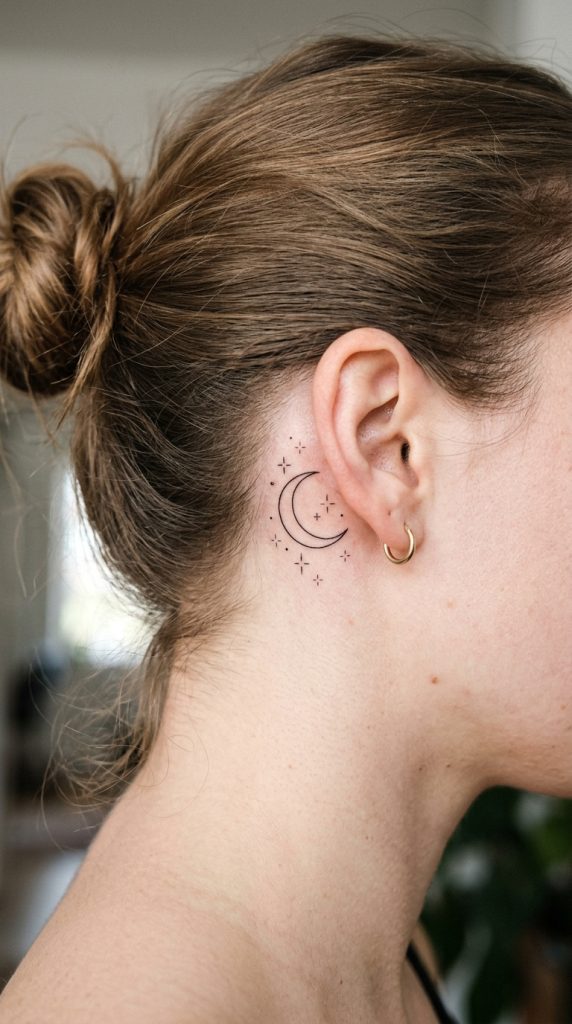
2. The Celestial Crescent & Starlight Cluster
Tapping into cosmic wonder and mystery, a celestial combination featuring a slender crescent moon surrounded by micro-starlight bursts fits the natural curve behind the ear flawlessly.
Design Specs & Placement Dynamics
- Aesthetic Style: High-contrast black ink with negative space highlights or subtle dot-work (stippling).
- Flow: A vertical alignment where the crescent moon frames the middle mastoid area, flanked by 2–3 tiny four-point sparkle stars.
- Color Palette: Pure solid black ink or a mix of black and soft grey washes to create depth.
- Placement Angle: Tilted slightly inward toward the head to maintain a clean profile view when viewed from behind.
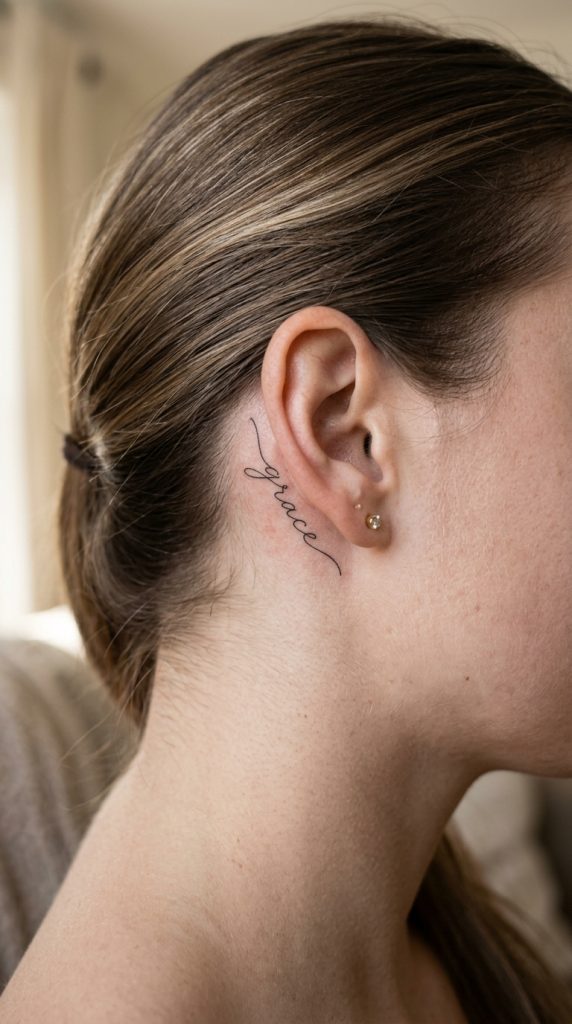
3. Minimalist Single-Line Script & Mantras
For women seeking personal inspiration, placing a single meaningful word, short quote, or important date behind the ear keeps the sentiment intimate yet stylish.
Design Specs & Placement Dynamics
- Typography Styles: Ultra-thin cursive script, minimalist typewriter font, or calligraphic lettering.
- Word Length: Keep words under 6–8 characters (e.g., grace, bloom, faith, solitude, or a year like 1998).
- Flow: Oriented vertically along the hair-crease line or horizontally tucked right beneath the lower lobe curve.
- Legibility Rule: Never drop font sizes too low. Letters with tight loops (like ‘e’, ‘a’, or ‘o’) must be kept open enough to prevent ink bridging over time.
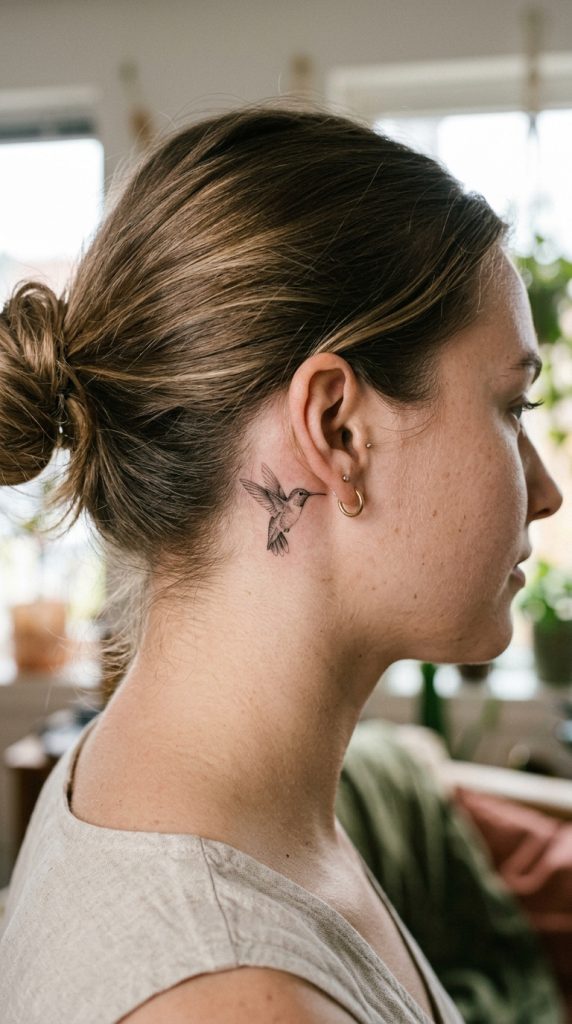
4. The Flying Hummingbird Silhouette
Symbolizing joy, resilience, and lightness of spirit, a tiny hummingbird captured mid-flight behind the ear adds dynamic movement to a static space.
Design Specs & Placement Dynamics
- Aesthetic Style: Micro-realism with grey wash shading, or a sleek solid black silhouette.
- Motion Placement: Angle the hummingbird so its beak points upward toward the top of the ear or forward toward the cheek, creating a sense of upward lift.
- Scale: Total design size should hover between $0.75\text{ and }1.25\text{ inches}$.
- Detailing: Focus detail on wing feather textures while keeping the tail feathers clean and uncluttered.
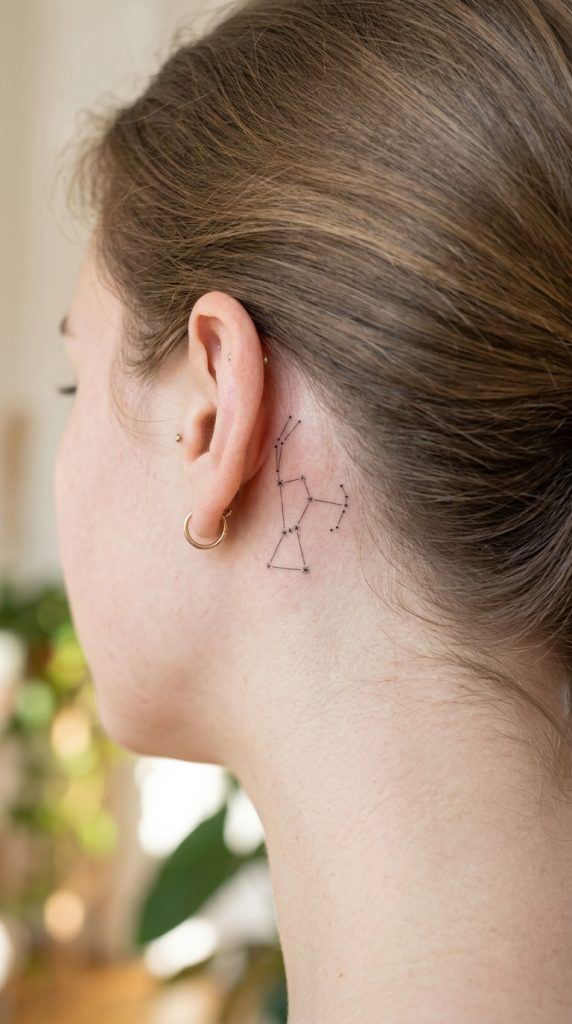
5. Delicate Constellation Mapping
A personal zodiac or cosmic constellation rendered with tiny dots and micro-lines creates an intriguing, abstract pattern that looks like a starry constellation map behind the ear.
Design Specs & Placement Dynamics
- Aesthetic Style: Geometric dot-work connected by whisper-thin vector lines.
- Customization: Choose your sun, moon, or rising zodiac star sign mapped out accurately.
- Visual Appeal: From a distance, it reads as an elegant cluster of freckles or minimal geometric dots; up close, it reveals a precise star map.
- Needle Precision: Requires a steady hand to keep connection lines straight and star nodes crisp.
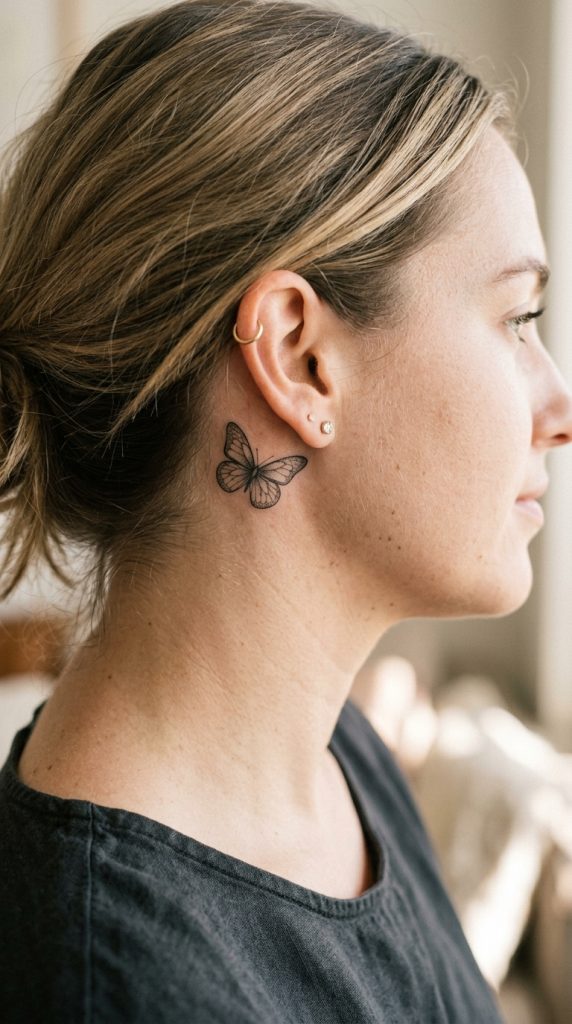
6. The Floating Butterfly in Motion
Butterflies represent transformation, freedom, and beauty. Placed behind the ear, a butterfly appears as though it has momentarily landed on your neck, creating a playful, graceful look.
Design Specs & Placement Dynamics
- Aesthetic Style: Micro-illustrative linework with subtle wing shading or delicate dot-work fill.
- Wing Perspective: A side-profile view (wings folded upward) fits narrow spaces best, whereas an open-wing view works well on the flatter mastoid bone plane.
- Placement Variations: Tuck it high near the upper cartilage or lower near the nape-and-ear junction.
- Color vs. Black & Grey: While soft pastel ink (blush pink, sky blue) looks soft, rich black and grey ink provides significantly better long-term durability behind the ear.
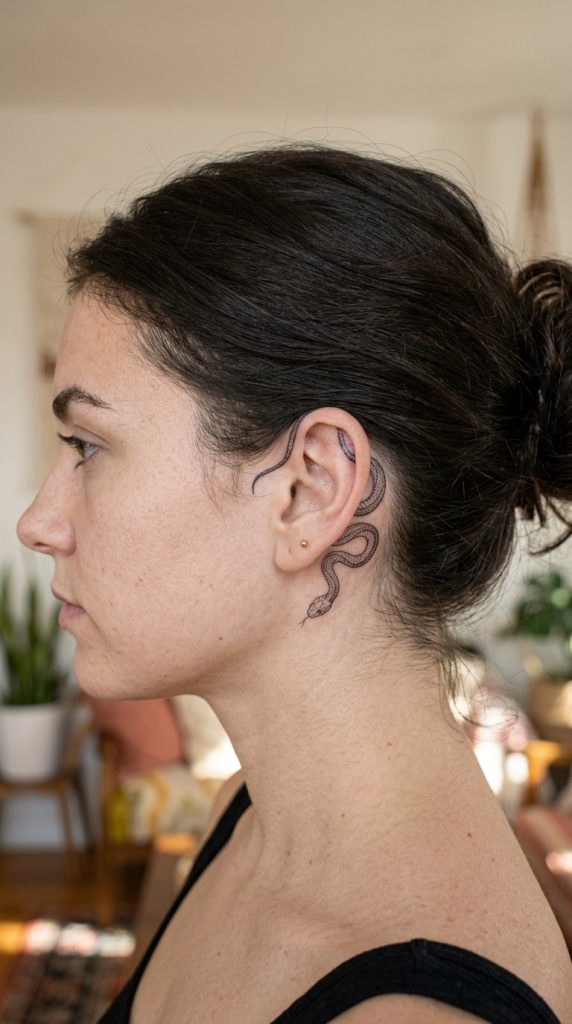
7. The Symbolic Snake or Serpent Wave
Representing rebirth, wisdom, and transformation, a sleek serpent coiling along the natural curve behind the ear offers an edgy, modern, and alluring aesthetic.
Design Specs & Placement Dynamics
- Aesthetic Style: Minimalist fine-line, illustrative blackwork, or micro-engraving style.
- Anatomical Integration: The snake’s body follows the S-curve of the ear crease, with its head tapering near the upper cartilage and tail subtly fading toward the neck.
- Detailing: Focus on clean body contours; scale patterns should be suggested through light stippling rather than heavy, dense lines.
- Visual Energy: Creates a powerful, bold statement that pairs exceptionally well with multiple ear piercings and ear cuffs.
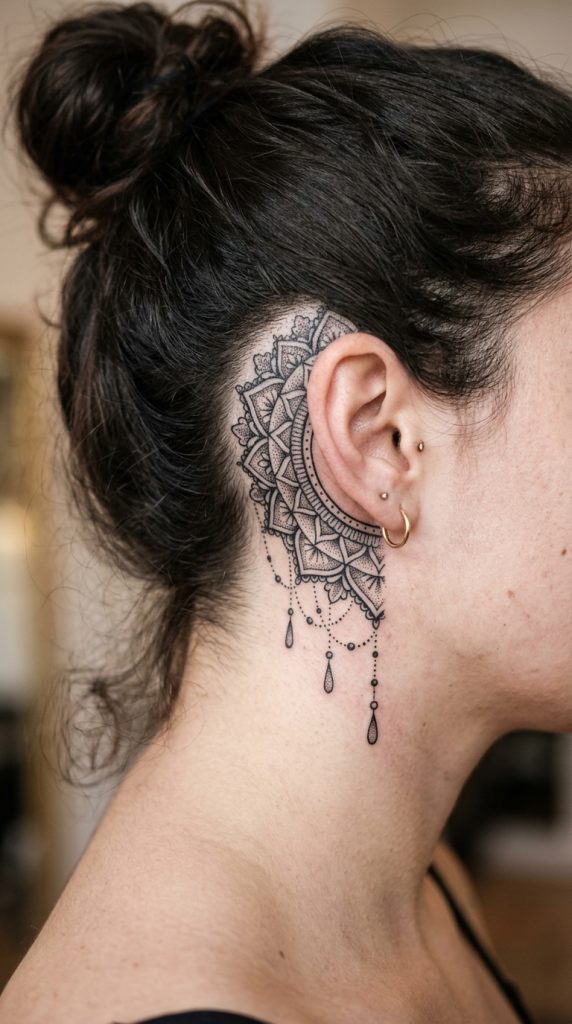
8. Soft Ornamental Lace & Mandala Curves
Drawing inspiration from architectural lace and sacred geometry, a half-mandala or ornamental drape hugging the back crease of the ear functions almost like permanent fine jewelry.
Design Specs & Placement Dynamics
- Aesthetic Style: Dot-work (stippling) combined with fine geometric arches and tiny drop-bead details.
- Flow: The design curves directly around the base of the ear cartilage, framing the ear like an intricate ear-cuff extension.
- Precision Factor: Demands strict symmetry along the curved plane to maintain a polished, jewelry-like feel.
- Negative Space: Relies on open skin areas inside the mandala petals to make the intricate linework pop cleanly.
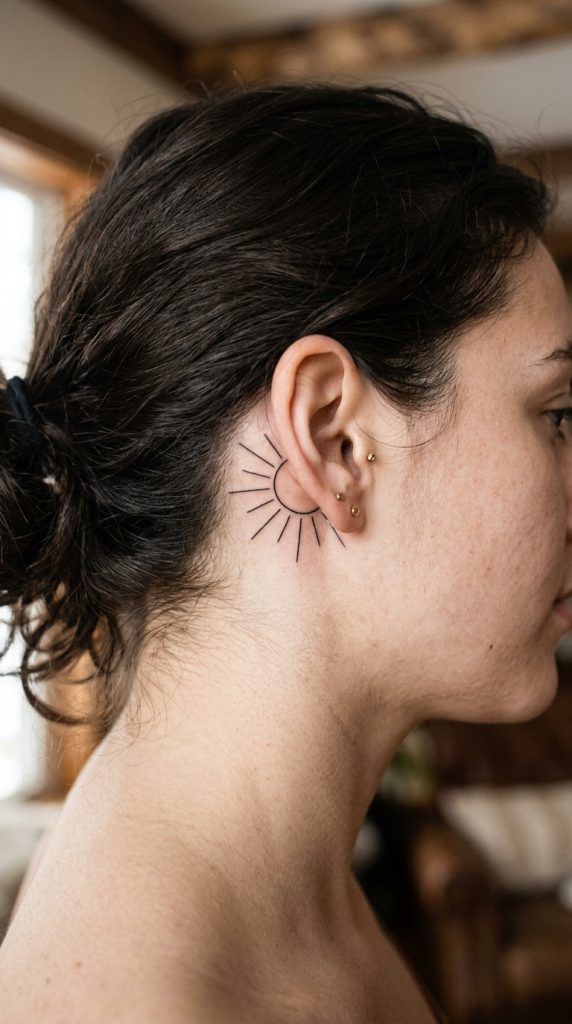
9. The Minimalist Sunburst & Rising Rays
Radiating warmth, energy, and positivity, a minimalist half-sun or fine-line sunburst peaking out from behind the ear creates a bright, uplifting visual anchor.
Design Specs & Placement Dynamics
- Aesthetic Style: Clean geometric line work with alternating long and short light rays.
- Placement Style: Nestled right along the crease line so the sun rays fan outward toward the back of the head and upper neck.
- Scale: Compact and round, measuring around $1\text{ inch}$ in diameter.
- Simplicity: Keep the center core of the sun hollow (negative skin) so the rays remain the main decorative element.
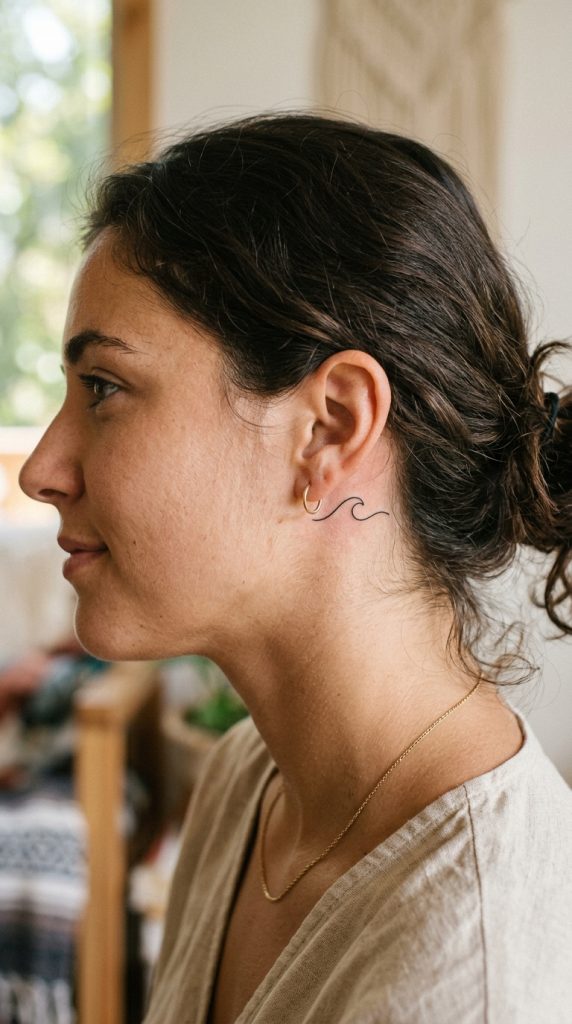
10. The Micro Wave or Fluid Element
For lovers of the ocean, nature, and minimalist geography, a micro-single line wave or fluid water stroke behind the ear represents adaptability, flow, and tranquility.
Design Specs & Placement Dynamics
- Aesthetic Style: Single continuous line or Japanese woodblock-inspired line stroke.
- Placement Angle: Positioned horizontally right behind the earlobe or angled diagonally along the lower mastoid drop.
- Subtlety Level: Extremely subtle and low-profile—ideal for a first tattoo or for those needing maximum discretion.
- Longevity: Simple, clean wave curves age gracefully with minimal maintenance required over time.