In a world increasingly dominated by fast-paced digital screens, hand embroidery offers a tactile, meditative antidote. Crafting thread art with your own hands allows for endless creative expression, bringing texture, color, and personal style into daily life. Beyond its therapeutic benefits, hand embroidery is an exceptionally accessible craft—requiring minimal initial investment while yielding timeless, heirloom-quality pieces.
Whether you are looking to personalize your wardrobe through upcycling, curate a textured gallery wall, or create heartfelt handmade gifts, working with needle and thread provides infinite versatility. From modern botanical line art to intricate raised stumpwork, hand stitching seamlessly bridges traditional craftsmanship with contemporary design.
Here is an architectural, structural, and creative guide to 10 creative hand embroidery project ideas, complete with technical specifications, material selections, essential stitch glossaries, and project workflows.
Technical Fundamentals, Fabrics & Embroidery Ergonomics
Before starting your stitching journey, establishing proper material choices, tension control, and spatial setups ensures smooth execution and professional results.
1. Fabric Selection & Stabilizers
- Natural Fiber Preference: Linen, cotton duck, unbleached calico, and denim offer tight, stable weaves that support thread weight without sagging or warping.
- Stabilizer Application: Use water-soluble toppers when working on stretchy knits (like T-shirts) or heavy tear-away backings when stitching intricate, high-density designs on lighter fabrics.
2. Needle & Thread Specifications
- Embroidery Floss: Six-strand cotton floss is the standard choice. Separate individual strands before recombining them to ensure flat, even thread lay.
- Needle Sizes: Use Size 3 to 9 embroidery (crewel) needles. Sharp tips pierce woven fibers smoothly without tearing threads.
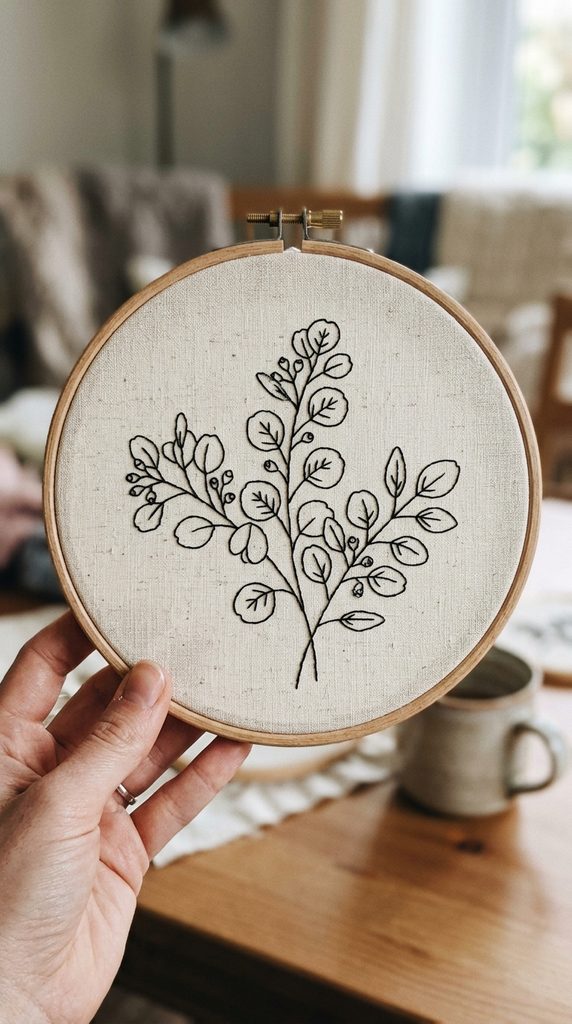
1. Botanical Line Art Wooden Hoop Display
Capturing delicate flora through clean, single-strand line drawings creates a modern, minimalist wall display that celebrates organic forms and subtle textures.
Technical Specs & Stitches
- Primary Stitches: Stem Stitch, Backstitch, and Whipped Backstitch for fluid, continuous lines.
- Fabric & Thread: Unbleached Belgian linen held in a $6\text{-inch}$ beechwood hoop, stitched using 1 or 2 strands of black or dark olive cotton floss.
- Execution Strategy: Trace fine continuous line illustrations of eucalyptus, ferns, or wild poppies onto the fabric using a heat-erasable friction pen before stitching.
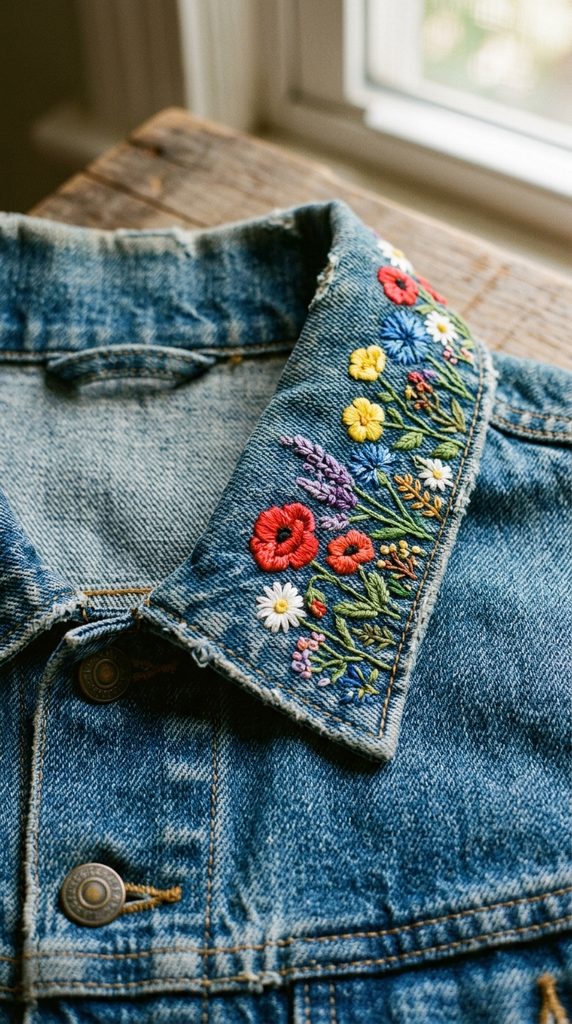
2. Upcycled Denim Jacket Collar and Cuff Embellishments
Transforming vintage denim jackets with vibrant floral or geometric embroidery gives worn clothing a custom, high-end designer feel while promoting sustainable fashion.
Technical Specs & Stitches
- Primary Stitches: Satin Stitch (for solid flower petals), Fishbone Stitch (for leaves), and French Knots (for textured flower centers).
- Fabric Prep: Denim is dense; use a sturdy Size 3 embroidery needle paired with 3 to 4 strands of floss to ensure clean fabric penetration.
- Placement Areas: Concentrate designs along lapels, upper shoulder yokes, or outer cuff bands to highlight the garment’s natural structural lines.
3. Textured Dimensional Landscape Hoop Art
Layering textured stitches allows you to build three-dimensional landscapes—featuring rolling hills, lavender fields, and cloud-filled skies—directly onto stretched canvas.
Technical Specs & Stitches
- Primary Stitches: Bullion Knots, French Knots, Cast-on Stitch (for raised flower spikes), and Long and Short Stitch (for blended sky gradients).
- Fabric Base: Heavyweight cotton duck canvas or sturdy linen blend.
- Color Blending Strategy: Blend two different thread shades in the same needle (e.g., mixing light purple and deep violet) to create realistic depth in floral fields.

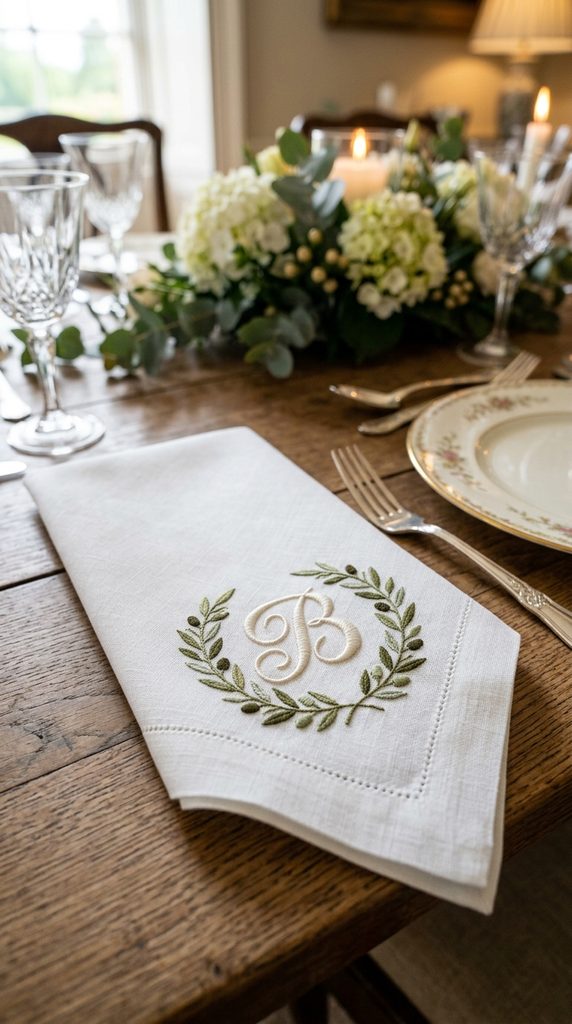
4. Personalized Monogrammed Linen Napkins & Handkerchiefs
Custom monogramming brings timeless elegance to dining table settings or bespoke wedding gifts, transforming daily linens into treasured keepsakes.
Technical Specs & Stitches
- Primary Stitches: Padded Satin Stitch (stitching satin stitches over a foundation layer of split stitches) and Granitos Stitch (for delicate leaf accents).
- Fabric Choice: $100\%$ pure linen napkins with hemstitched borders.
- Precision Tip: Keep the back of your work exceptionally neat by weaving thread ends under existing stitches rather than tying bulky knots.
5. Embroidered Celestial Zodiac Star Maps
Stitching golden constellations, moon phases, and cosmic map details onto dark fabric creates a striking, atmospheric textile artwork.
Technical Specs & Stitches
- Primary Stitches: Couching (for trailing orbit lines), French Knots (for stars), and Metallic Thread Backstitch.
- Fabric Base: Deep midnight blue or jet black velvet or heavy cotton.
- Metallic Thread Handling: Metallic threads fray easily; use shorter thread lengths ($12\text{ inches}$ max) and thread conditioner (wax) for smooth pulling.

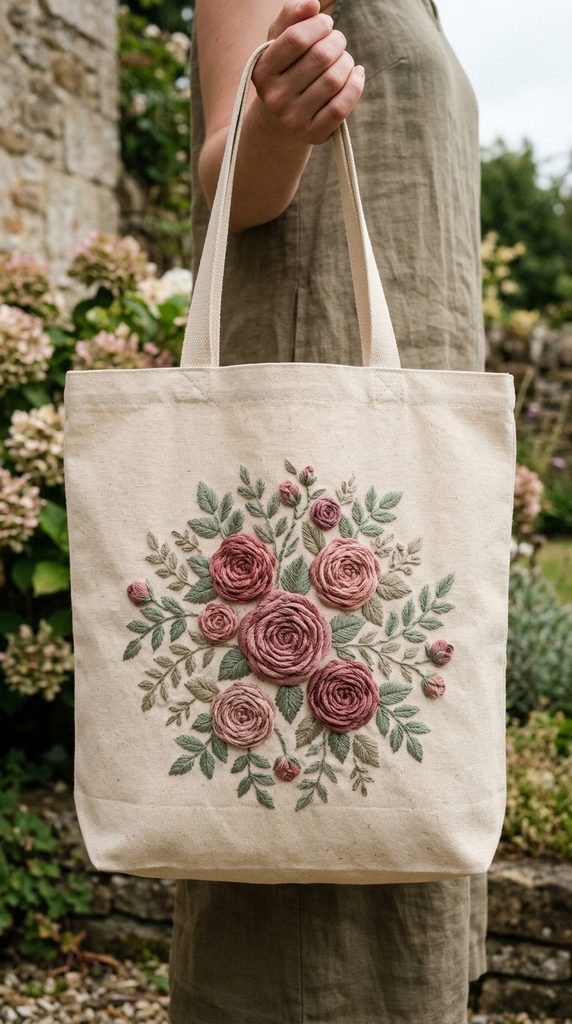
6. Woven Wheel Rose Canvas Tote Bag
Upcycling a plain cotton canvas tote bag with bold, three-dimensional woven wheel roses results in a stylish, durable accessory for daily errands.
Technical Specs & Stitches
- Primary Stitches: Woven Wheel (Spider Web Rose), Lazy Daisy (Detached Chain Stitch), and Leaf Stitch.
- Fabric Base: Heavyweight natural cotton canvas.
- Durability Step: Once stitching is complete, iron a piece of fusible woven interfacing over the back of the stitches inside the bag to protect them from friction.
7. Thread-Painted Pet & Animal Portraits
Thread painting uses micro-blended stitches to capture realistic fur textures, shadows, and expressive eye details in pet portraits.
Technical Specs & Stitches
- Primary Stitches: Long and Short Stitch (the core stitch for thread painting) and Single Strand Straight Stitches.
- Technique: Work exclusively with 1 strand of cotton floss to achieve seamless color transitions and fine fur detail.
- Layering Flow: Stitch from the background forward—stitching ears and neck fur first, ending with the nose and shiny highlights in the eyes.

8. Custom Embroidered Canvas Shoes & Sneakers
Adding hand-stitched floral sprigs or abstract geometric motifs to canvas sneakers creates one-of-a-kind footwear with personal flare.
Technical Specs & Stitches
- Primary Stitches: Anchor Stitches, Heavy Chain Stitch, and French Knots.
- Tools Required: Use a curved upholstery needle or a thimble-backed crewel needle to navigate tight shoe toe boxes and thick canvas.
- Protection Step: Spray finished shoe embroidery with a water- and stain-repellent fabric protector spray to keep stitches clean during wear.

9. Interactive Felt & Embroidery Quiet Book Pages
Crafting tactile, interactive quiet book pages for young children combines soft felt shapes with durable embroidery to teach fine motor skills and shapes.
Technical Specs & Stitches
- Primary Stitches: Blanket Stitch (for joining felt edges), Running Stitch, and Buttonhole Stitch.
- Material Palette: Premium wool-blend felt sheets paired with thick perle cotton thread (Size 8).
- Safety Rules: Ensure all stitched elements, buttons, and ribbons are double-anchored securely to prevent choking hazards.

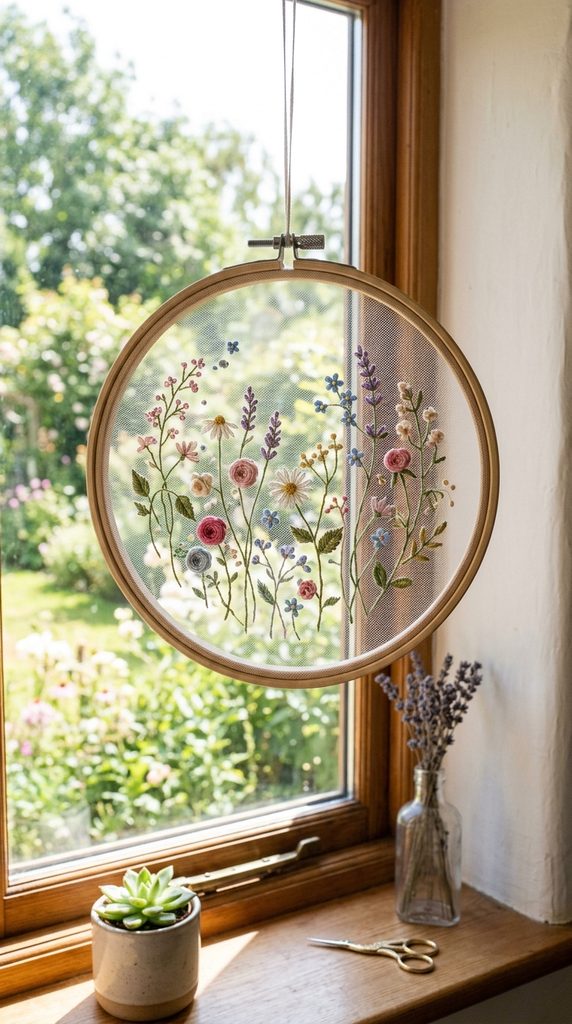
10. Embroidered Sheer Tulle Sun Catchers
Stitching lightweight floral motifs onto sheer organza or tulle fabric creates ethereal, floating artworks that catch light beautifully when hung near windows.
Technical Specs & Stitches
- Primary Stitches: Fly Stitch, Chain Stitch, and Satin Stitch executed with light tension.
- Fabric Base: Synthetic or silk tulle netting or sheer organza stretched tightly in a display hoop.
- Tension Control: Maintain gentle, consistent stitch tension to prevent gathering or tearing delicate sheer mesh fibers.