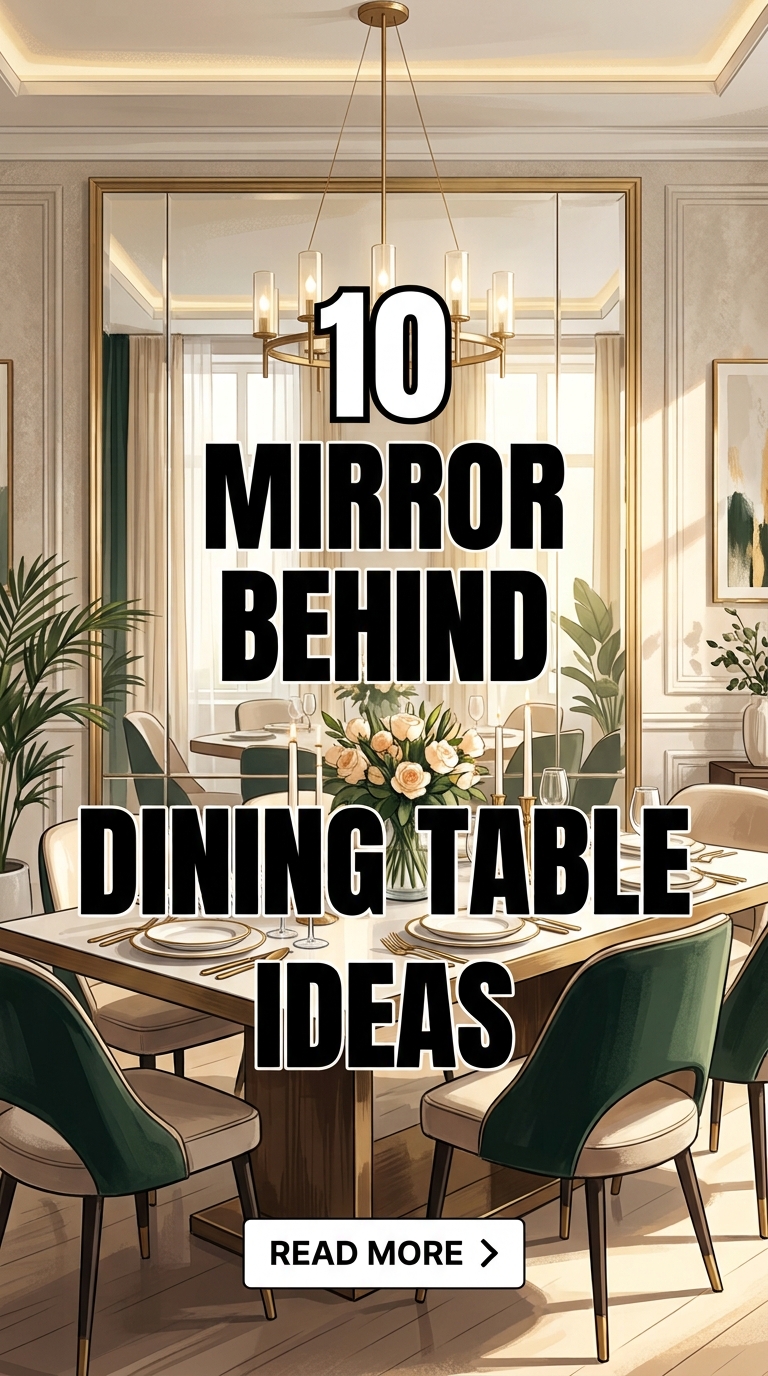
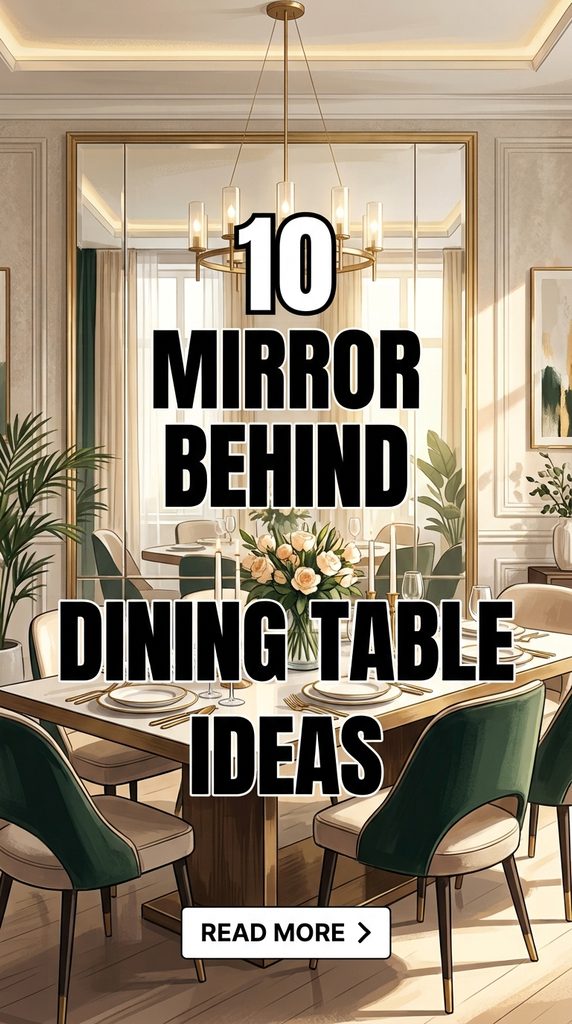
In interior architecture, the dining room serves as a central hub for hospitality, conversation, and family gatherings. Placing a strategically selected mirror behind the dining table is one of the most effective ways to elevate the space. A well-positioned mirror does far more than act as a decorative wall piece; it reflects light, creates an illusion of expanded square footage, enhances chandelier illumination, and establishes a clear visual focal point.
From grand antiqued mirror grid walls to modern organic floating silhouettes, mirrors introduce dynamic spatial depth to dining environments. Achieving a balanced look requires careful attention to spatial proportions, frame materials, hanging sightlines, and reflected ambient elements.
Here is a comprehensive guide to ten dining room mirror concepts, complete with spatial guidelines, lighting reflections, frame material breakdowns, and structural hanging protocols.
Spatial Dynamics & Reflective Sightline Foundations
Before choosing mirror dimensions or frame materials, master these foundational interior design principles:
1. The Proportional Scale Rule
- Mirror Width: A single focal mirror mounted horizontally above a dining buffet or directly behind the dining table should measure 60% to 75% of the total length of the dining table or side credenza beneath it.
- Vertical Positioning: Hang the center point of the mirror at standard eye level—approximately 57 to 60 inches from the finished floor. When positioning above a dining server or sideboard, leave 6 to 12 inches of vertical clearance between the top of the furniture and the bottom edge of the mirror frame.
2. Intentional Reflection Mapping
Always evaluate what the mirror will reflect from a seated dining position:
- Ideal Reflections: Crystal chandeliers, warm ambient lighting, statement artwork on opposite walls, architectural arches, or outdoor garden views through windows.
- Reflections to Avoid: High-traffic kitchen prep zones, open utility doorways, clutter, or direct harsh light sources that create eye-straining glare for dinner guests.
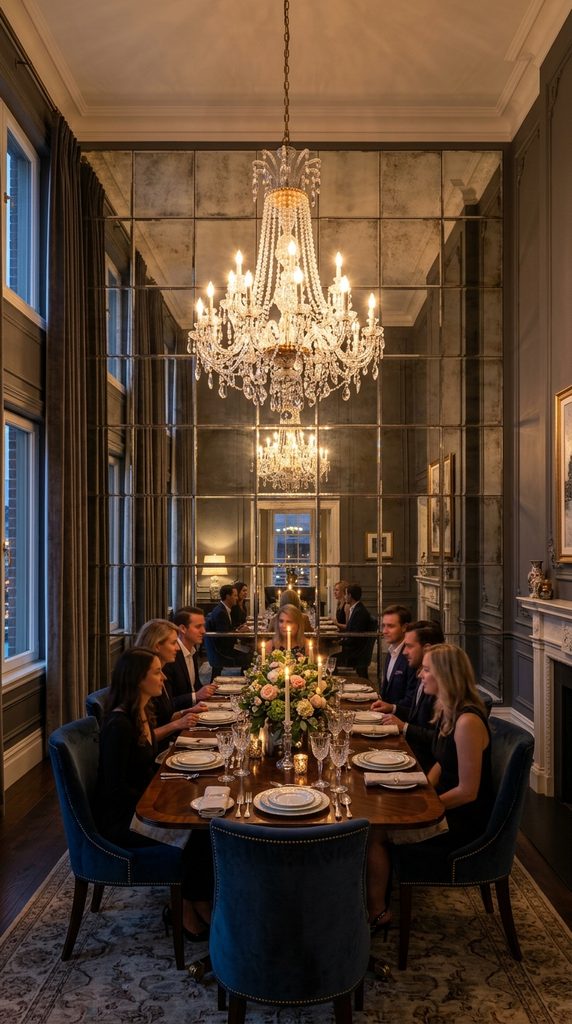
1. The Antiqued Mirror Glass Grid Feature Wall
Covering the entire accent wall behind the dining table with antiqued glass tiles introduces classic European grandeur while softening reflections with a subtle vintage patina.
Architectural Layout & Styling Strategy
- Color & Material Palette: Foxed antiqued glass with silver and charcoal patina distressing, bevel-edged glass joints, and muted antique gold brass rosettes.
- Wall Execution: Install a full-scale grid of $18\times24\text{-inch}$ bevel-edged antiqued mirror tiles directly onto a reinforced backing wall. The mottled finish diffuses light softly, preventing high-contrast reflections while adding rich texture.
- Lighting Pairings: Position a warm tier crystal or brass chandelier ($2700\text{K}$) directly in front of the grid wall to catch subtle light flickers across the antiqued glass surface.
- Dining Style Pairing: Complements classic French bistro, traditional formal dining rooms, and transitional spaces.
Design Tip: Antiqued mirror walls eliminate the starkness of clear mirror glass, creating a softer, more intimate background for evening candlelit dinners.
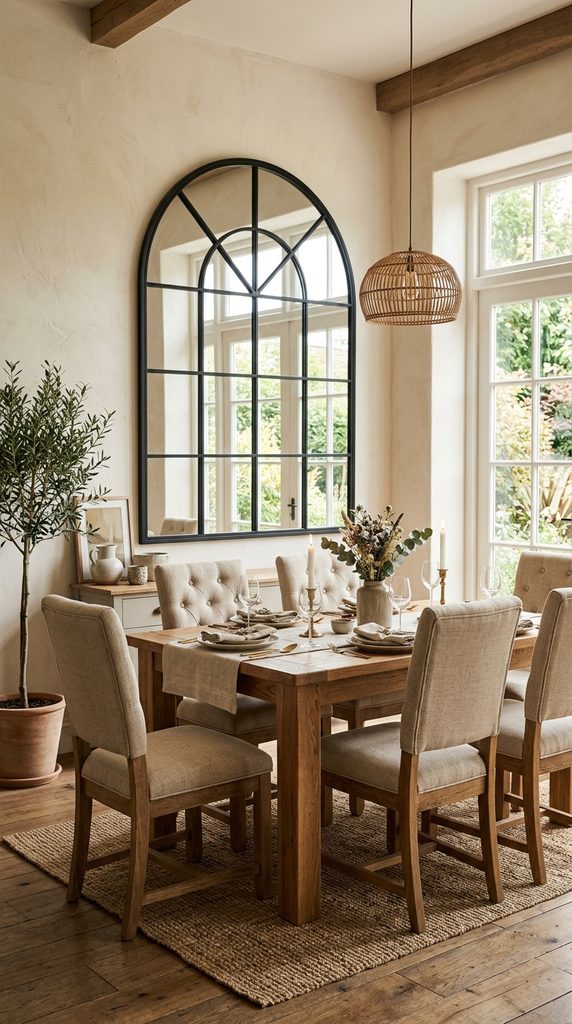
2. The Grand Architectural Arched Windowpane Mirror
Inspired by historic conservatory windows, a large floor-leaning or wall-mounted arched windowpane mirror introduces height, structure, and cathedral-like grandeur.
Architectural Layout & Styling Strategy
- Color & Material Palette: Matte black wrought iron or dark bronze metal framing, clear mirror glass panels, and warm oak dining finishes.
- Spatial Dimensions: A towering $42\times84\text{-inch}$ arched mirror mounted centrally behind a 6-to-8-person dining table.
- Visual Impact: Vertical arch lines draw the eye upward toward ceiling crown moldings, making standard $8\text{-foot}$ or $9\text{-foot}$ ceilings feel noticeably taller.
- Styling Integration: Pair with a solid oak dining table, woven linen dining chairs, and matte black candle sconces flanking either side of the arch.
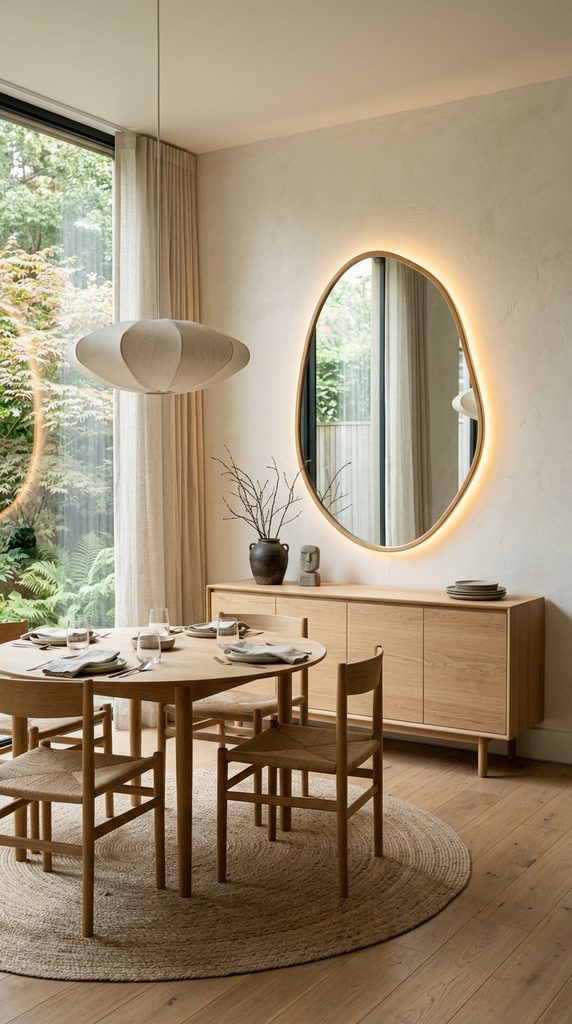
3. The Modern Asymmetrical Organic Floating Mirror
Breaking away from traditional rigid lines, an oversized fluid, pebble-shaped, or organically curved mirror acts as a living art sculpture behind contemporary dining furniture.
Architectural Layout & Styling Strategy
- Color & Material Palette: Frameless polished edges or ultra-thin brushed brass rim, clear distortion-free glass, and minimalist concrete or marble walls.
- Spatial Dimensions: An irregular $36\times54\text{-inch}$ fluid silhouette mounted offset behind a sleek dining credenza.
- Concealed Lighting: Install warm LED strip lighting ($3000\text{K}$) behind the floating backing structure to project a soft halo glow onto the wall surrounding the organic curve.
- Dining Style Pairing: Ideal for mid-century modern, ultra-contemporary, or Japandi-inspired dining room interiors.
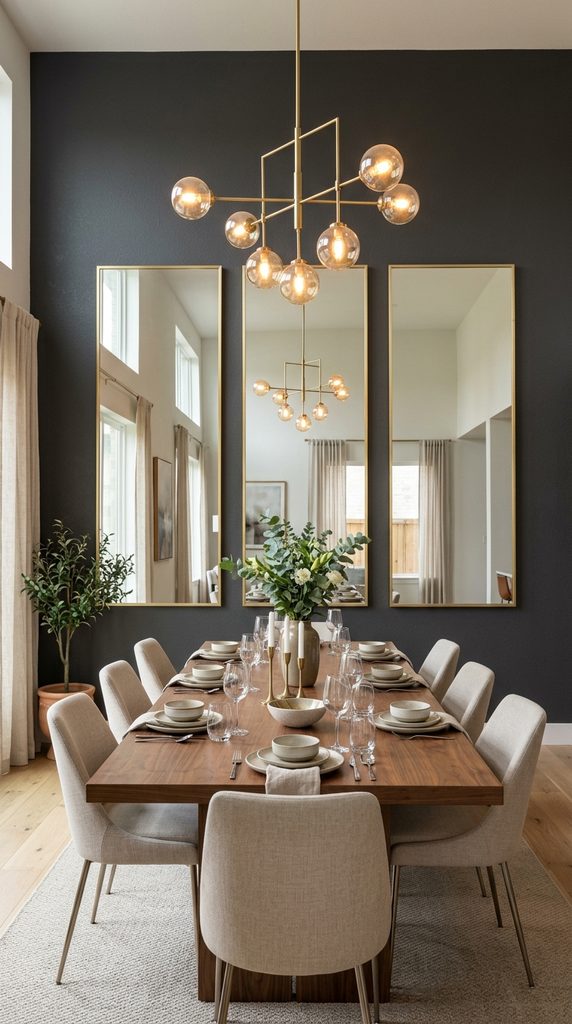
4. The Triptych Vertical Mirror Panel Set
Arranging three tall, slender matching mirrors side by side creates rhythmic symmetry while mimicking the appearance of floor-to-ceiling architectural windows.
Architectural Layout & Styling Strategy
- Color & Material Palette: Satin brass, dark walnut timber, or polished chrome thin frames with clear mirror inserts.
- Spatial Dimensions: Three identical $18\times60\text{-inch}$ vertical panels spaced precisely 3 to 4 inches apart across the main dining wall.
- Symmetrical Balance: The gaps between the panels allow the wall color behind to show through, creating a framed rhythm that spans the entire length of a 6-to-10-person table.
- Decorative Additions: Position a low-profile floral arrangement or a series of tall brass candleholders along the credenza below to align with the vertical panel grid.
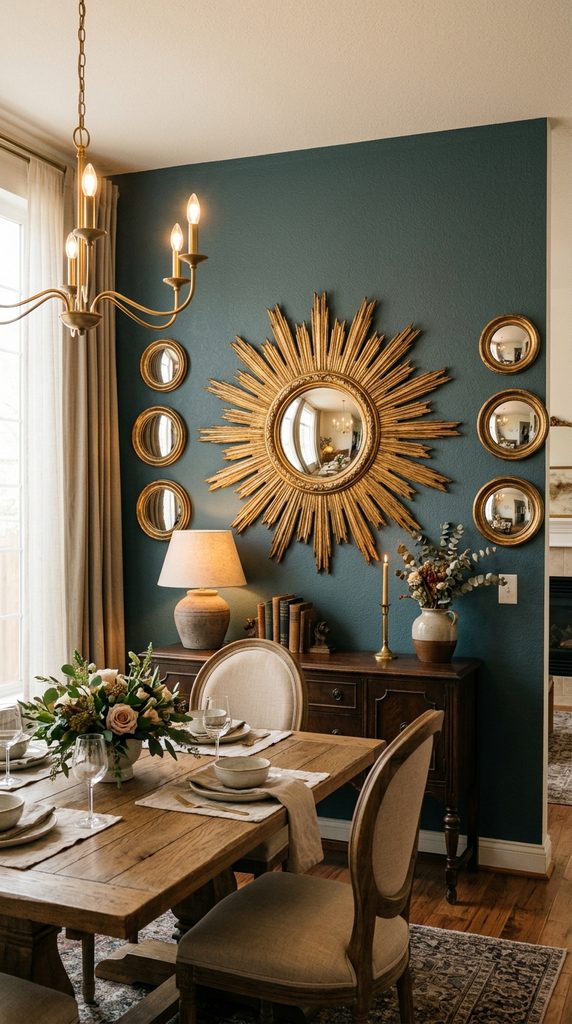
5. The Sunburst Convex Accent Mirror Array
Combining a central oversized convex or starburst mirror with smaller satellite mirrors creates a dramatic focal point that bounces light across multiple angles.
Architectural Layout & Styling Strategy
- Color & Material Palette: Antiqued gold leaf, hand-carved giltwood, or aged brass metal rays surrounding a center glass mirror.
- Spatial Dimensions: A primary $36\text{-inch}$ starburst mirror centered behind the table, flanked by four to six smaller $10\text{-to-}12\text{-inch}$ accent mirrors arranged in a balanced composition.
- Reflective Characteristics: The central convex glass lens compresses the entire dining room view into a wide-angle, painterly miniature reflection.
- Dining Style Pairing: Perfect for Hollywood Regency, eclectic glam, and transitional dining spaces.
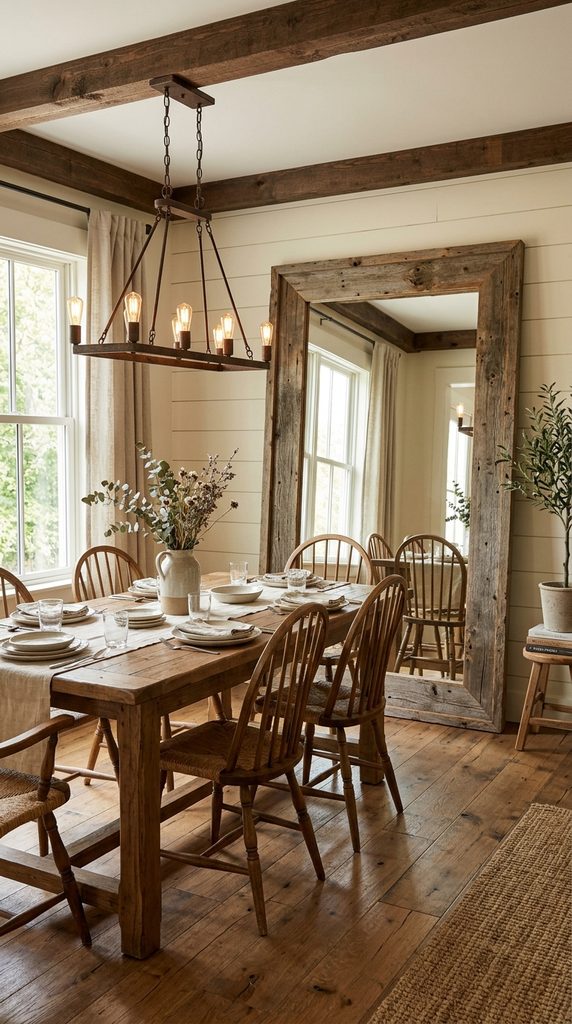
6. The Oversized Rustic Timber Framed Floor Mirror
Leaning an oversized, thick timber-framed floor mirror directly against the wall behind the table introduces casual, relaxed luxury and maximum light reflection.
Architectural Layout & Styling Strategy
- Color & Material Palette: Weathered reclaimed oak, distressed pine, or rough-sawn timber with a matte clear coat finish.
- Spatial Dimensions: A heavy $48\times90\text{-inch}$ full-length floor mirror angled securely against the wall.
- Structural Safety Protocol: Anchor the top frame corners directly into wall studs using heavy-duty anti-tip steel brackets to prevent tipping accidents.
- Textural Contrast: The rugged timber texture balances sleek polished dining tables, brass light fixtures, and velvet upholstered seating.
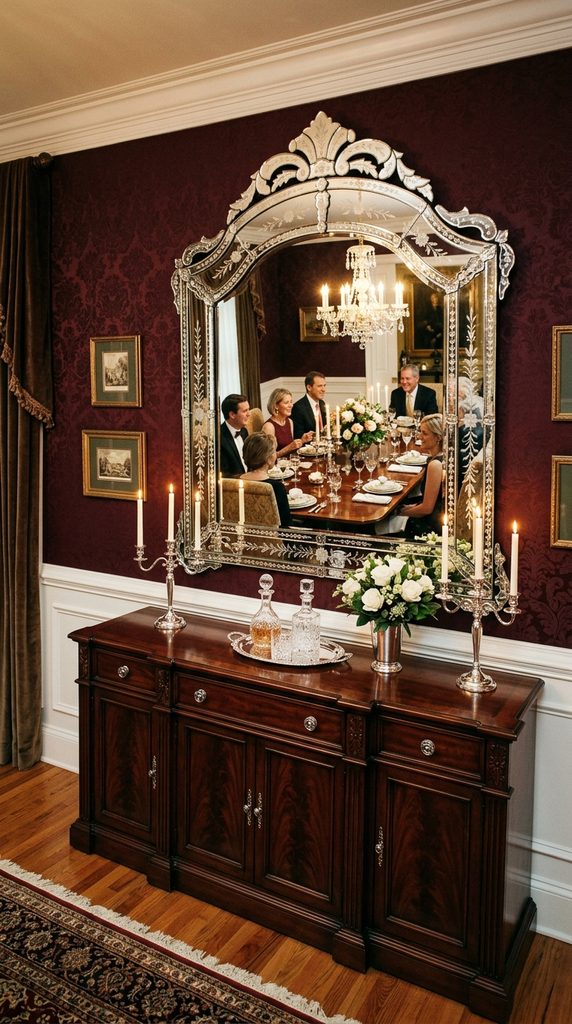
7. The Venetian Etched Glass Decorative Wall Mirror
Renowned for intricate craftsmanship, Venetian-style mirrors feature delicate hand-etched floral glass borders and ornate crown crests, bringing classic romantic sophistication to formal spaces.
Architectural Layout & Styling Strategy
- Color & Material Palette: Silvered hand-etched glass, bevel-cut glass scrollwork, and subtle antique mirror rosettes.
- Spatial Dimensions: A $32\times50\text{-inch}$ vertically oriented Venetian crest mirror centered over a dark mahogany or walnut buffet cabinet.
- Reflective Quality: Etched border details catch ambient dinner light, creating a sparkling frame around the clear center reflection.
- Dining Style Pairing: Complements classic traditional, neoclassical, and romantic glam dining rooms.
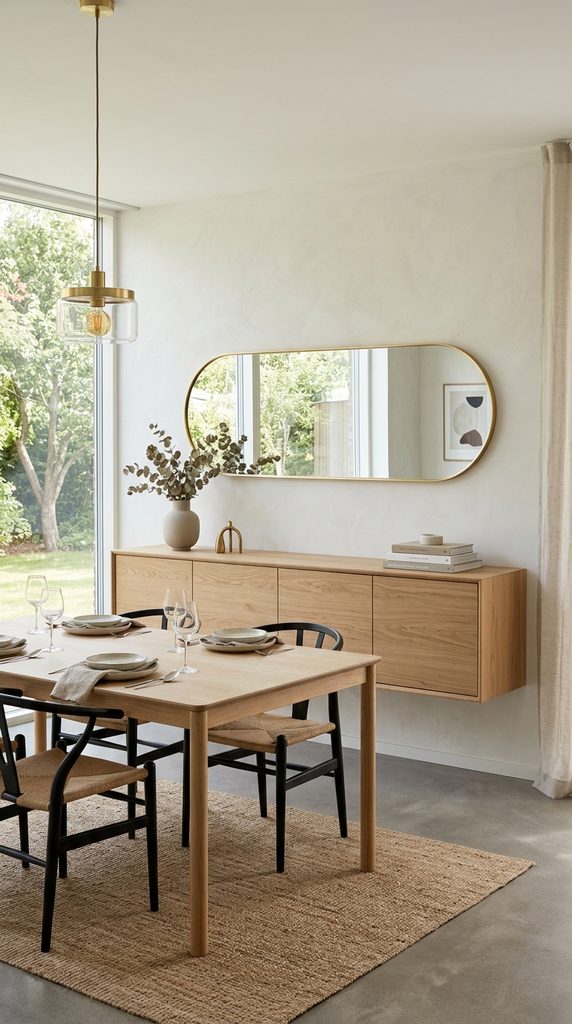
8. The Minimalist Horizontal Brass-Rimmed Capsule Mirror
A long, pill-shaped or capsule mirror oriented horizontally spans the width of the dining table, establishing clean horizontal lines and a streamlined modern look.
Architectural Layout & Styling Strategy
- Color & Material Palette: Brushed brass, matte black, or rose gold metal rim ($1/4\text{-inch}$ thin edge) with ultra-clear low-iron mirror glass.
- Spatial Dimensions: A $24\times60\text{-inch}$ horizontal capsule mirror hung directly above a floating wooden dining sideboard.
- Proportional Flow: The rounded pill-shaped ends soften sharp dining table angles and rectangular cabinetry lines beneath it.
- Styling Additions: Pair with minimalist linear pendant lighting fixtures and ceramic vase arrangements.
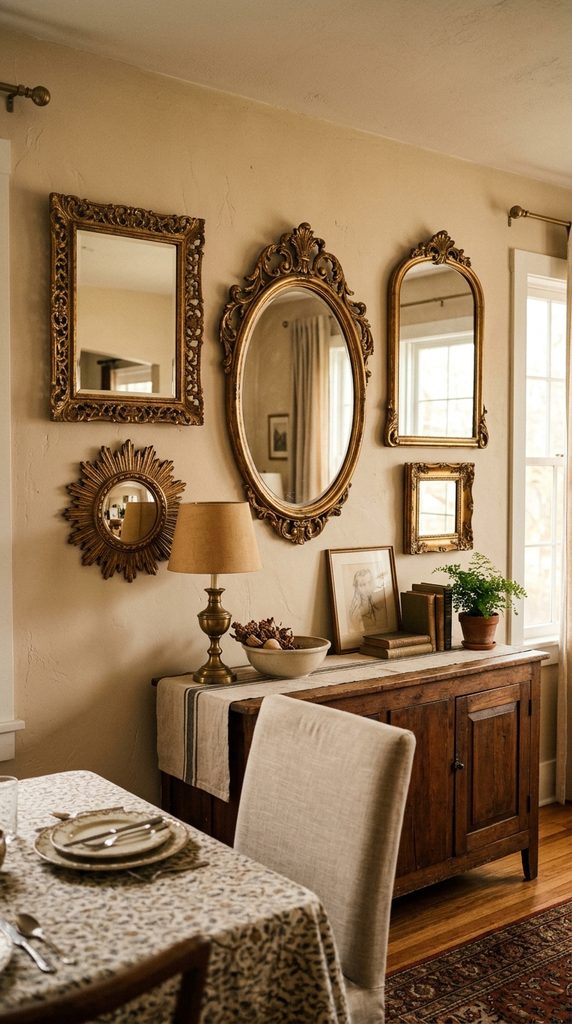
9. The Gallery Wall Array of Mismatched Vintage Gold Mirrors
Grouping multiple antique giltwood mirrors in varied shapes and sizes transforms a blank dining wall into a personal collector’s display.
Architectural Layout & Styling Strategy
- Color & Material Palette: Aged brass, tarnished gold leaf, warm bronze, and carved wooden frames with varied patinas.
- Spatial Arrangement: Combine five to seven distinct vintage mirrors (oval, rectangular, octagonal, arched) in a balanced cluster above the sideboard.
- Layout Strategy: Maintain a uniform 2-to-3-inch space between frame edges, keeping the overall outer perimeter balanced above the table length.
- Dining Style Pairing: Ideal for bohemian chic, eclectic vintage, or traditional collector-style homes.
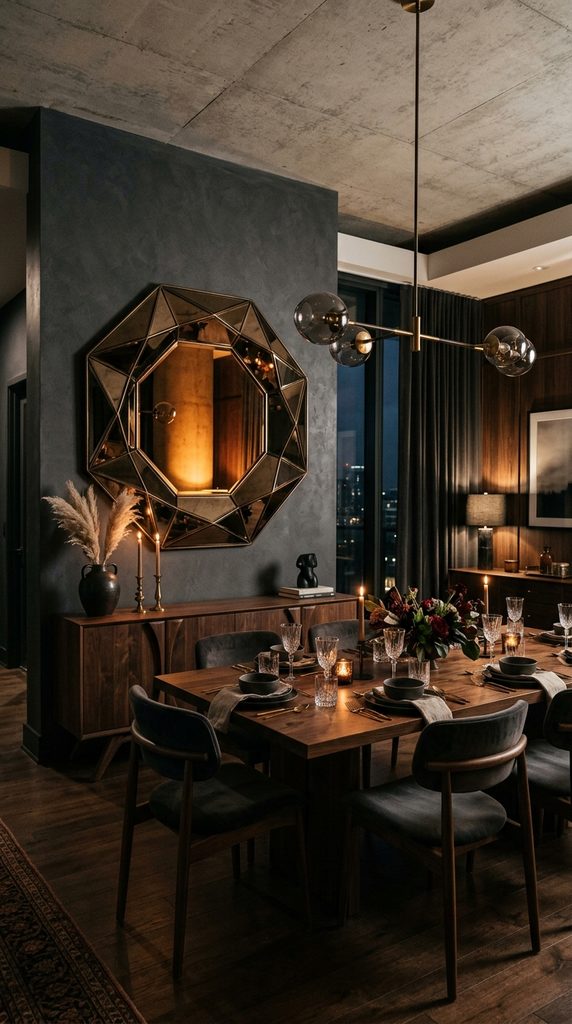
10. The Smoked Bronze Tinted Geometric Statement Mirror
Incorporating warm bronze, rose gold, or smoked gray tinted mirror glass introduces rich ambient color while reducing glare in brightly lit dining spaces.
Architectural Layout & Styling Strategy
- Color & Material Palette: Smoked bronze tinted mirror glass, geometric matte black metal grid framework, and dark walnut furniture.
- Spatial Dimensions: An octagon or large diamond geometric grid measuring $40\times40\text{ inches}$ centered behind the table.
- Mood Lighting Integration: The bronze tint absorbs harsh highlights, transforming reflected light into a warm, atmospheric glow ideal for evening dinner parties.
- Dining Style Pairing: Suits modern moody dining rooms, moody industrial spaces, and sophisticated urban apartments.